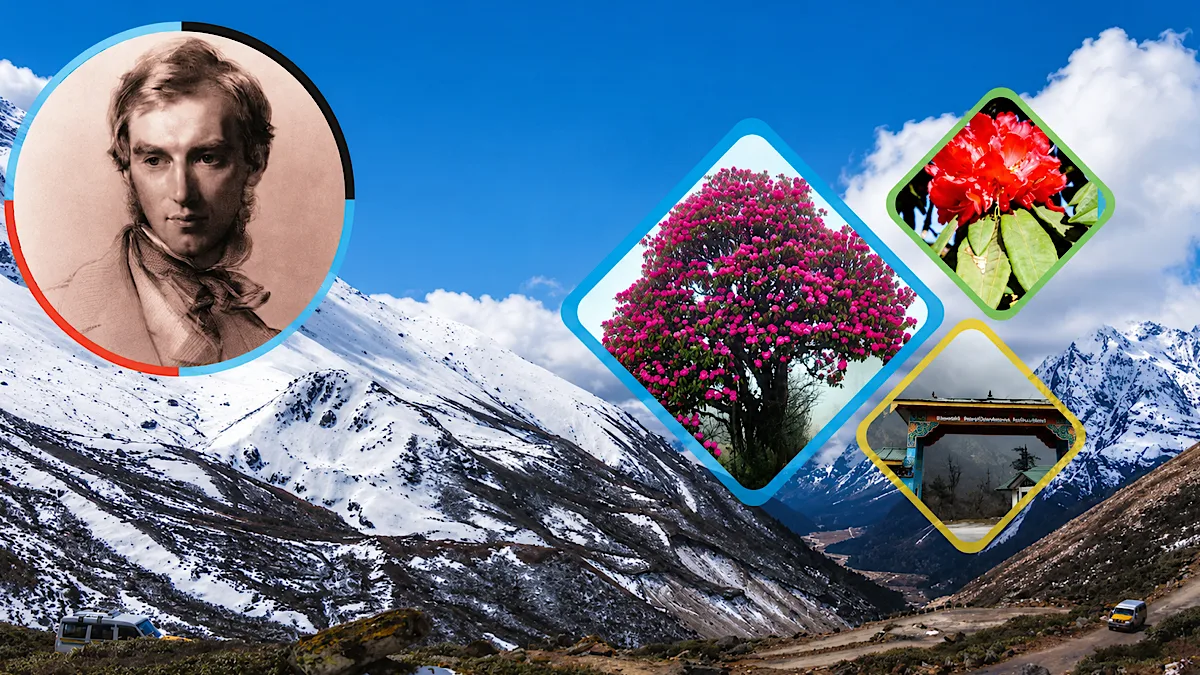
In May 1849, on a misty afternoon, the British botanist Sir Joseph Dalton Hooker stood on a steep, wind-carved ridge in the Lachung Valley. His fingers were numbed by the sub-zero air of the Eastern Himalayas. In his Himalayan Journals, Hooker described how he was surrounded by “a wilderness of floral beauty”, meticulously sketching a specimen of Rhododendron niveum, its pale purple blossoms glowing softly against the dark, wet slate of the cliffs. He also noted the precise altitudinal coordinates and the exact weeks of its bloom, anchoring the flower in the static amber of Victorian science.
One hundred and seventy-seven years later, in the spring of 2026, the mountain changed its mind. Hooker, who saw a frozen kingdom slowly waking up in mid-May, would find that today’s “rhododendron scribes”, local guides, indigenous conservationists and forest watchers, are witnessing a very different reality. The mountain has already bloomed and faded by mid-April. The Eastern Himalayas are shifting their calendar, and Hooker’s journals have suddenly transformed from quiet relics of colonial botany into some of the most precise climate-change diaries we possess.
Advertisement
“Hooker wasn’t just a collector, he was a mapmaker of time,” says Dr Rinzing Lopo, a Sikkimese plant ecologist who has spent almost a decade tracking plant transitions in the high-altitude Shingba Rhododendron Sanctuary. Speaking from his temporary field cabin in Lachung, Dr Lopo points to a digital scan of Hooker’s 1849 hand-coloured plates. Recent phenological data, the study of natural cycles and seasonal timing, sugge s t t h a t peak blooms in the subalpine zones of Sikkim have advanced significantly.
Advertisement
Species such as the blood-red Rhododendron arboreum, which historically waited for the late spring sun of April, are now bursting into colour as early as late February or early March. This is not a triumph of early spring. It is a symptom of a fever. Average maximum winter temperatures in the high-altitude Himalayan zones have steadily crept upwards, tricking the plants into believing spring has arrived weeks ahead of schedule. For the indigenous Lepcha and Bhutia communities living in the shadow of Mount Kanchenjunga, the rhododendron, locally known as Guras, is not merely a tourist attraction but a cultural compass.
“The hills are climbing,” exclaims Tenzing Lepcha, a 58-year-old traditional naturalist and community forest guard from Yumthang. He is one of Sikkim’s true “rhododendron scribes”. “Plants do not have legs, but they are running from the heat,” Tenzing explains, pointing towards the jagged grey peaks. “As the lower valleys warm up, the seeds that fly upward gradually find the cold they need to survive. They are migrating to higher altitudes.” This “upward migration” is a quiet ecological crisis. If the tree line shifts too rapidly, fragile alpine meadows are squeezed out, endangering the species that depend on them. The danger of an early bloom is not simply a shift in calendar dates.
It is the breaking of ancient ecological relationships. “In the forest, timing is everything,” explains Dr Lopo. He adds, “The rhododendrons have spent millennia synchronising their blooms with the arrival of specific pollinators, high-altitude bumblebees, sunbirds and butterflies. If the flowers bloom three weeks early because of a warm February, but the insects do not hatch until their usual time in April, the chain is broken.” Without pollinators, the flowers fail to set seed, threatening the long-term survival of the forest. Conversely, the insects arrive only to find that their primary food source has already withered away.
Moreover, this shift has disrupted local cottage economies. Sikkim’s forest-adjacent communities have long harvested fallen rhododendron petals to make Guras juice, squash and traditional local wines. “We used to collect the petals in late May, when the tourist season was winding down,” says Maya Devi Chettri, a local entrepreneur in Lachen. “Now the flowers fall when the roads are still blocked by late winter snow or early landslides. We are losing both the flowers and the tourists.” The irony of modern Sikkim is that the very beauty Hooker popularised in the West is now under threat from its own popularity. Every spring, thousands of tourists crowd the narrow mountain passes of North Sikkim to witness the “Valley of Flowers”.
While eco-tourism has brought undeniable prosperity to remote mountain homestays, it has also imposed a heavy environmental cost. Emissions from idling diesel SUVs carrying tourists to Yumthang create a localised greenhouse effect in the narrow valleys, further accelerating the melting of nearby glaciers and warming the microclimate. “We are caught in a paradox,” notes Tenzing Lepcha. “We need tourism to put food on our tables, but the heat from the vehicles and the trash left behind on the trails are choking the very flowers people come to see. We have to learn to walk softly on these mountains, the way Hooker did, on foot.”
To walk the Sir Joseph Hooker Trail in 2026 is to witness a silent dialogue between the past and the present. In the quiet hours of the morning, before the tourist vehicles begin their noisy ascent, the forest belongs to the scribes. Armed with handheld GPS devices, modern researchers stand beside local guides such as Tenzing. They compare digitised plates from 1849 with the living, fragile branches of Rhododendron niveum. The colonial botanist wrote his journal to conquer and categorise the unknown. The modern mountain scribes write theirs to preserve what is rapidly slipping away.
Advertisement